 Michael Epps Utley
{kind=image/jpg}
Content is easier for AI search engines to understand and quote when it’s structured for extractability, which means the degree to which a specific section can be parsed, compressed, and reused by an AI system like ChatGPT, Claude, Gemini, or Perplexity without losing its core meaning. Four principles help make content extractable: it answers a specific question, organizes each idea into a self-contained passage, names the people and products involved, and supports claims with clear evidence. These practices also help people quickly find and use the information they need.
While traditional SEO helps search engines discover, index, and rank your content, extractability is about how clearly that content communicates an answer once it’s accessed. A page can be discoverable yet contain passages that are difficult to interpret or reuse accurately.
In examining extractability for Generative Engine Optimization (GEO), we’re presenting a blog that illustrates the structure in action. Essentially, we’re taking AEO and GEO best practices to the extreme. Every H2 is a question that marketers, content writers, and brand managers would ask about AI search, followed by a direct, quotable answer that makes sense on its own. Together, they give you a practical how-to guide.
Why Should Content Lead With the Answer?
Leading with the answer gives readers and AI engines the information they’re looking for immediately, making the main point easy to identify. Answer-first structure states the core claim by putting a direct answer, definition, or solution in the first two or three sentences at the head of a section or block of text rather than burying it beneath the backstory.
For AI search, focus on your headings first. Base H2s on the questions people are asking and open each section with a clear answer that makes sense on its own. A sentence that stands on its own gives AI systems an answer they can use, even when they combine it with other sources. Keep necessary qualifications beside the claim so an extracted sentence remains accurate.
What Makes a Sentence Clear Enough to Quote?
A sentence is easier to quote accurately when it names its subject, makes one clear point, and includes any qualification needed to understand the claim. Direct language that plainly states what something is or does reduces ambiguity while leaving room for a recognizable voice.
Here’s a hypothetical then and now:
Then: “Our solutions streamline healthcare logistics.”
Now: “Acme Health’s scheduling software sends automated appointment reminders to patients of multi-location specialty clinics and integrates with your EHR software.”
The first version is accurate but generalized. The second version names the product, the buyer, and a distinguishing detail you can check.
There are three stages that content can reach in AI search while on its way to being quotable. Each is separate from the others.
1. Content is understood: the AI correctly interprets what your page says.
2. Content is used in an answer: the AI draws on your content to build the response someone sees.
3. Content is cited: the AI names or links to your brand as the source.
A page can satisfy the first stage and still miss the second or third. Clear writing improves your odds at each stage (but it doesn’t guarantee the next one).
How Does One Idea per Block Make Content Easier to Use?
A self-contained content block explains one idea without leaving readers to reconstruct its meaning from several other sections. Short, focused paragraphs, descriptive headings, and appropriately labeled lists or tables make answers easier to locate and interpret.
Some content strategists call this ‘atomic content’: one complete idea per block, usually in two to four sentences. Format is important here, so be sure to match your information to the best layout. This is your guide to that:
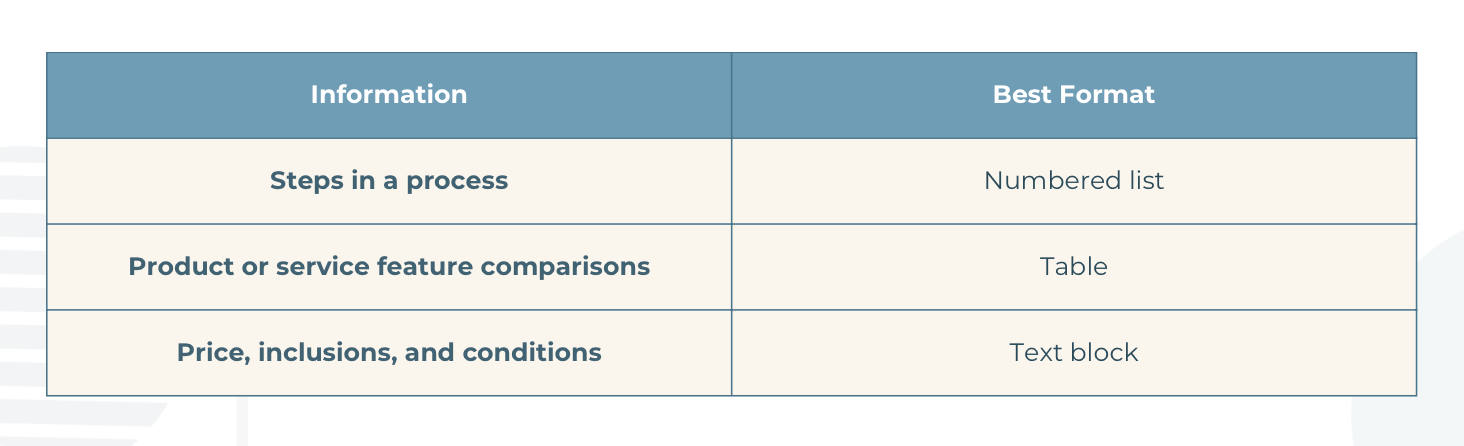
For the last row’s content block, keep a service’s price, inclusions, and conditions together in one block so that any passage AI lifts stays accurate instead of conveying an erroneous price point.
Why Do Specific Names and Verifiable Details Matter?
Specific names and verifiable details clarify who or what a statement is about and give readers a way to check it. Name the business, product, location, date, and any conditions that apply instead of broad claims or vague references.
This is called “entity-rich” writing: naming actual people, organizations, products, and places (the entities). “Our software improves clinic efficiency” could describe anything. “Acme Health’s billing software submits claims to Medicare and Medicaid” describes one product, and buyers can verify it. Any research claims you make need a source and enough context to interpret them.
Together, naming shows whose product or service it is, while evidence and methodology give people and AI systems reasons to reference it.
How Can You Keep Expertise Connected to Your Brand?
Give your service a specific identity that readers and AI systems can distinguish from general advice in your field. Pairing your name with clear definitions, documented features, and original advice makes the connection to your brand explicit and harder for AI to flatten into generic content.
Define the offering in one plain sentence: what it is, who it’s for, and what it includes. Then explain how it works. Substance comes from a defined method, clear interpretation, and original findings.
Can Content Still Be Creative and People-First When AI Citation Is the Goal?
Content should remain engaging, informative, and useful to the people it’s targeting. Writers can still use stories, humor, and metaphors while providing an explicit answer so audiences can enjoy the writing without feeling as though it’s geared toward machine interpretation and extraction.
Writing for humans should always be your goal. Solve a problem, explain a choice, or help someone act or choose. Don’t forget that Google continues to advise helpful, reliable, people-first content for its AI search features. State the answer, then let a brief scenario or analogy make it memorable. This is where gifted content writers make a difference. They understand how to differentiate products and services by writing with a human, brand-aligned voice, while also ensuring the content is structured for AI extractability.
How Can AEO by GoEpps Help Your Business Compete in AI Search?
AEO by GoEpps shows you where your business stands in AI search against your four closest competitors, then gives you a prioritized plan to close the gaps. Each month, AEO by GoEpps scores you across 43 metrics and rolls the results into a SuperScore from 1 to 100, tracked across six AI engines. You get a dashboard with trendlines and an easy-to-understand list of the highest-impact moves you can make next.
Book a free strategy call to see where you stand in AI search today and where your biggest opportunities exist. Make your expertise easier to find and harder to overlook.