 Michael Epps Utley
{kind=image/jpg}
Imagine an awards event where others keep getting nominated, and you keep missing out. In AI search, a shortlist of winners is being built every time a potential customer asks which provider to consider. The difference, though, is this: you can learn why competitors keep making the cut and use this information to improve your own chances. There’s never a guarantee with AI search mentions and citations, but there are ways to stack the deck in your favor.
To find the AI search visibility gap between you and your competitors, there are a few tried-and-true (so far) steps to follow. Start by testing common buyer questions across AI search platforms and compare how often each business appears. Build a list of 20 to 30 realistic prompts, repeat each test under consistent conditions, and record brand mentions and website citations separately. The results reveal which buying questions competitors appear for when your business goes unmentioned, giving you specific opportunities to investigate and to prioritize the marketing efforts that will close that gap.
Let’s dig a little deeper…
Which Questions Should You Test to Perform Better in AI Search?
Your prompts should reflect the questions buyers ask when they’re choosing a provider.
Build your prompts based on data from sales calls, customer emails, and recurring questions and objections from potential customers. Use the language your buyers use. If a customer asks for “IT help for a small office,” that’s your prompt. Also check the top search terms your site ranks for using Google Search Console or AWT. Google’s autocomplete suggestions can help you find related questions and phrases. This can reveal discovery insights you may not have been aware of.
Include questions about location, industry experience, budget, and comparisons. For an IT services company, these might include:
What’s the best IT support company for a small law firm?
Who offers the best managed IT services in [city]?
What should a 30-person business expect to pay for outsourced IT?
How do I choose the best IT support company for a small law firm in [city]?
What are the alternatives to [competitor] for a small business?
Keep the questions that name a competitor in a separate group from those that don’t. For the unbranded questions, you’re looking for brands that appear when you haven’t specifically asked about them, so you can investigate their visibility and find opportunities to improve your own.
Choose three to five of your closest competitors. You now have your test set: a consistent collection of questions you can run to compare visibility and track changes over time.
Running a Consistent AI Search Test
A relevant benchmark repeats the same prompts with the same settings, so the results compare apples to apples, even though the answers will differ. One platform might mention your business while another might ignore you completely. Even asking the same platform the same questions two or three different times can deliver slightly different answers.
Test the prompts a buyer would type into ChatGPT, Perplexity, Google AI Mode, Claude, or Gemini. Run the prompts under controlled conditions and score who shows up:
Use a logged-out session where available, or an account with memory and personalization turned off.
Start a fresh conversation for each test, keeping the wording neutral and consistent.
Specify your buyers’ location by running “best in [city]” and similar questions.
Run each prompt several times, recording how often each brand is named or cited. GoEpps’ Performance Manager and SEO/GEO/AEO specialist Ryan Lannum recommends two to three repetitions for a manual AI visibility check.
You can also test AI Overviews separately in regular Google Search, and record whether AI Overview appears for each query. Then track any brand mentions and website citations within it.
Track your business and the same three to five competitors within those answers. Record the platform, date, settings, and linked sources so you can repeat the exercise accurately later. These steps give you a baseline, despite variations in AI answers. What you’re looking for are patterns.
To begin, create a grid with the prompts down the side and brands across the top. Use a separate tab for each platform and record how often each business appears across your repeated tests.
For example, three runs of the same question might produce these results:
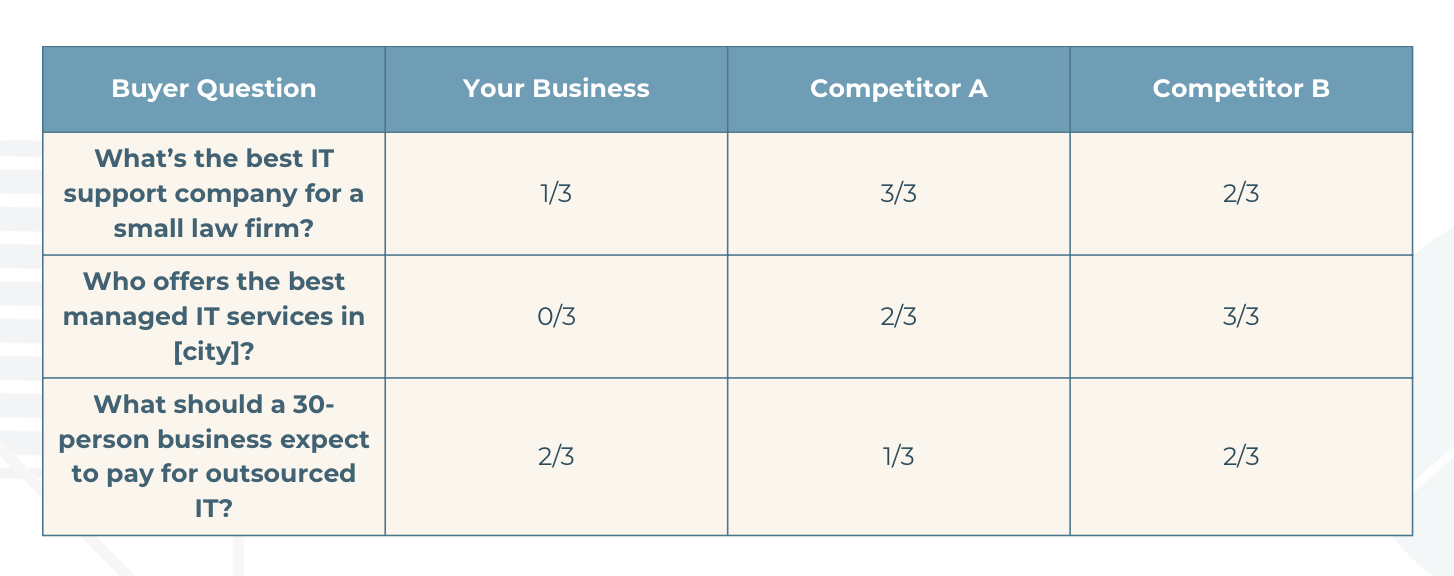
This table reflects how many answers named the business. You’d track website citations separately. These hypothetical results count each brand once per answer; a mention doesn’t necessarily mean a recommendation.
Testing 20 to 30 questions manually across the same four platforms three times each means reviewing 240 to 360 responses and keeping track of every mention and citation. This can be extremely tedious and time-consuming.
AEO by GoEpps offers ongoing competitive benchmarking on your behalf, measuring your business against your top four competitors on ChatGPT, Gemini, Copilot, Perplexity, Claude, and Grok, across 43 metrics each month and providing insights and prioritized recommendations. With our proprietary tool, you can see where you stand, where opportunities exist, and the highest-impact moves you can make to improve your performance in AI search (without building the prompts or tracking results yourself).
Which Visibility Gaps Should You Address First?
Start by checking for technical crawl and bot-access issues, unclear business information, and missing or inaccurate brand facts. Then prioritize the gaps on questions that closely match your products or services and are likely to influence a buying decision.
Here’s where your grid fits in. Identify which competitors appear repeatedly where your business goes unmentioned. Review the linked sources for those responses. Does a competitor have a clear industry-specific service page, relevant case studies, or PR coverage? Investigating these clues can guide the most urgent, goal-oriented marketing efforts you can put into play to improve your brand’s performance.
After making changes to a service page, correcting business details, pursuing additional third-party coverage, or answering a recurring buyer question more clearly on your site, repeat the original tests, keeping the conditions consistent, and look for signs that the gap is narrowing.
Bring your growth goals and closest competitors to a free strategy call with GoEpps. We’ll review where your brand stands in AI search and discuss which opportunities you should act on first. Let’s make your next visibility move a strategy that puts your business on the AI shortlist.